
How to German Schmear Brick (Mortar Wash Fireplace Makeover)
Learn how to German schmear brick, in no time! Makeover a brick fireplace with mortar wash, a beginner-friendly DIY project.
As much as I love the cozy features in our cottage-style home, some of it is a bit dark for my liking. For example, our east-facing living room only gets morning light, making it dim in the afternoons. Though I like the chunky wood trim, I'm not tied to the brick fireplace or mid-tone walls. Therefore, a German schmear brick fireplace makeover was a solution to brighten the living room.
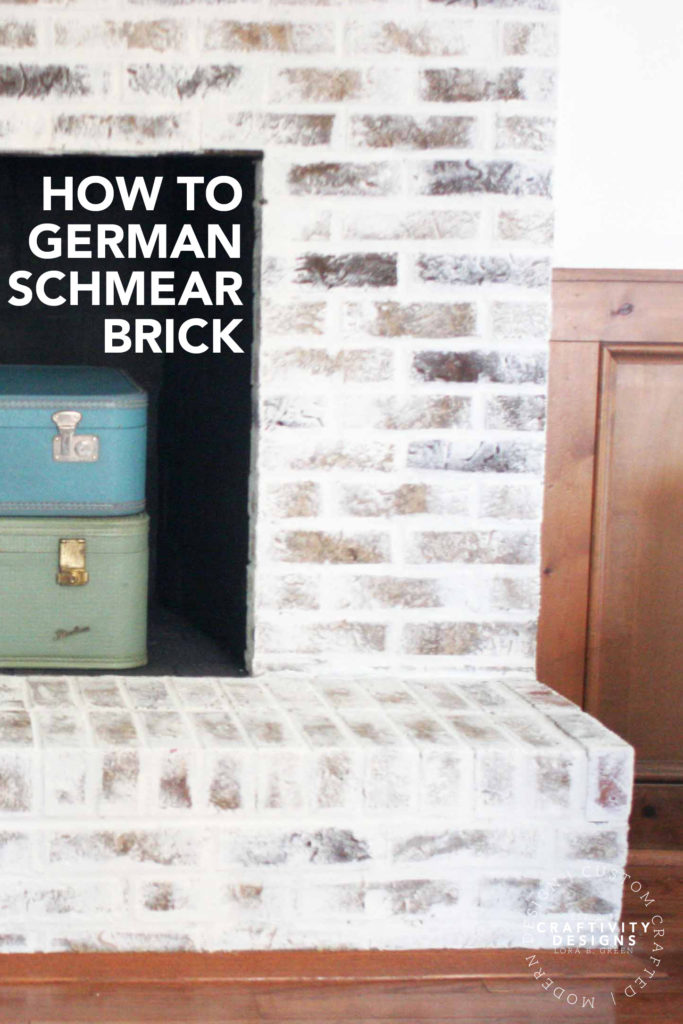
German schmear, like a whitewash, doesn't fully cover the brick. While I like painted brick, I felt retaining some amount of exposed brick would be true to the modern cottage design concept we've chosen. So, if you are a brick lover, a German schmear is a great compromise -- lighter and brighter, while still preserving character.

What is a mortar wash?
A mortar wash is a decorative effect which involves strategically spreading a mixture of mortar and cement across brick.
The term German schmear (or German smear) has origins in Germany from the word "schmear" meaning "to spread, grease, smear."

Unlike a whitewash, which is typically thin paint or paints thinned with water, the German schmear technique uses a thick medium. Mortar is the traditional medium, or use paint for a faux treatment. Completing German schmear with paint is simpler, and achieves a similar look.
You might also like: What are the differences? German Schmear vs. Mortar Wash vs. Limewash
Save Your Favorite Ideas & Get Updates
- Save your favorite content (from my site and thousands of other sites including: home, DIY, craft, recipe, and travel blogs)
- Receive my weekly newsletter
- Gain access to my Freebie Library
How to German Schmear Brick
Note: This tutorial utilizes paint. If you want to try mortar, I suggest this mortar wash tutorial from Dimples and Tangles.

Supplies Needed
- Satin Wall Paint (my fireplace is SW Alabaster)
- Paint Brush
- Plastic Dropcloths
- Painters Tape
- Vacuum
Instructions
- First, vacuum the brick to remove dust, debris, and cobwebs.
- Once clean, cover the mantel, firebox opening, floor, trim, etc. with plastic dropcloths and painters tape.
- Now, dip the paint brush into the paint. There is no need to cover the brush in paint, only the tip of the brush.
- Next, run the brush tip over the mortar surrounding a brick, generously applying paint.
- Once the mortar is covered with paint, use the paintbrush (without adding paint) to spread the paint from the mortar and across the brick. This smears the paint over the face of the brick... hence, the name "German schmear."
- Finally, repeat steps 3-5 until all of the mortar on the fireplace is covered. If you aren't satisfied with the coverage, apply a second coat.
Note: For reference, my fireplace has two coats of German schmear. It took less than 4 hours to complete, including dry time and cleanup. I used less than 1 gallon of paint.


Note: Looking for living room light ideas? The light in the photo above brightened our entire room.
DIY German Schmear Projects
German schmear can be used on interior or exterior brick - even on faux bricks! If you're considering giving german schmear a try, you'll want to check out the following posts, too:
- Before and After Photos of German Schmear Fireplaces
- Before and After Photos of Exteriors with German Schmear
We couldn't be more pleased with our german schmear fireplace, and plan to use the technique on the exterior of our modern cottage home and on the basement fireplace.

FAQs
A mortar wash uses a mortar/cement mix or with undiluted paint. A whitewash requires thin paint or paints diluted with water.
No. However, using paint and primer in one may reduce the total number of coats required.
Skip expensive brushes since the brick will be tough on the brush bristles. Ideally, choose a brush that is thick enough to cover the mortar lines, and approximately 2 inches wide. This will make painting the mortar quick and easy.
No. German schmear is a dry brush technique.
Yes! If your firebox is dingy and dirty, give it a fresh coat of paint, as well. Use a heat-safe paint as described in this tutorial about how to paint the firebox.

How to German Schmear Brick (Mortar Wash)
Learn how to German schmear brick, in no time! Makeover a brick fireplace with mortar wash, a beginner-friendly DIY project.
Materials
- Plastic Dropcloths
- Painters Tape
- Interior Satin Paint
Tools
- Paint Brush
- Vacuum
Instructions
- First, vacuum the brick to remove dust, debris, and cobwebs.
- Once clean, cover the mantel, firebox opening, floor, trim, etc. with plastic dropcloths and painters tape.
- Now, dip the paint brush into the paint. There is no need to cover the brush in paint, only the tip of the brush.
- Next, run the brush tip over the mortar surrounding a brick, generously applying paint.
- Once the mortar is covered with paint, use the paintbrush (without adding paint) to spread the paint from the mortar and across the brick. This smears the paint over the face of the brick... hence, the name "German schmear."
- Repeat steps 3-5 until all of the mortar on the fireplace is covered. If you aren't satisfied with the coverage, apply a second coat.
Notes
For reference, my fireplace has two coats of German schmear. It took less than 4 hours to complete, including dry time and cleanup. I used less than 1 gallon of paint.
If you liked this DIY project, you might also like:
- How to Install a Faux Brick Backsplash
- Learn How to Paint a Brick Fireplace (and the best paint to use!)
Want to save this fireplace makeover for later? Pin it!


Did you mix the paint with water??
Nope! It's a dry brush technique so you don't add any water.
Looks really nice! What color is your wall paint next to the fireplace, SW Alabaster as well?
Thank you, Julie! Yes, it is SW Alabaster on the walls, too! I've really like SW Alabaster in this home and have used it in our adjoining dining room, kitchen, and living room.
do u think
this will work on Black mortar and dark brick?
Yes, I think it would work fine. You may need additional coats of paint over the black mortar, since the color will show through more.
Hi! Curious if you think the SW Alabaster would work on red brick as well or look too cream? I like your technique of painting rather than having to deal with messy mortar, I assumed a white paint would do but does the Alabaster mimic mortar color more? Thanks! Fireplace looks beautiful!
Thank you, Korey! SW Alabaster is a bit creamy. I used a bright white on these two projects (also brick): https://craftivitydesigns.com/how-to-paint-brick/ and https://craftivitydesigns.com/faux-brick-backsplash/
The reason I chose SW Alabaster for the german schmear is that I didn't want it to feel so modern/new. The creaminess in SW Alabaster I felt would give it more of an aged look. But, we also have Alabaster on the wall next to the fireplace. So, if I had gone with a pure white, it would have looked even whiter next to Alabaster. All that being said... I think that either would work with red brick! Good luck 🙂 I'd love to see a pic when you are done!
Hi my brick fireplace seems like it is "finished" the bricks are shiny and seem sealed. I just bought the house so I have no idea if they've been treated with anything. Is there anything I should do before I try this process?
Oh, that is interesting! Such a great question. My guess would be that the paint would still apply just fine. However, the combo of satin paint (which is more matte) and shiny brick, might highlight the fact that the brick is shiny... if that makes sense? I'd be inclined to try a spot that is less obvious. If anything, you may want to use a semigloss sheen in order to balance the sheen of the brick, rather than highlight it. Thanks!
I'll try that, thank you so much!!!
Hi Raquel,
I also have a fireplace with shiny sealed bricks. I am thinking about using this technique with oil based paint. If you tried this method, I would love to hear how it went for you and if you have any words of wisdom to share.
The mortar on my fireplace is quite deep so using a regular 2” paintbrush and getting it all also covers quite a bit of the surrounding bricks. I may try a narrower brush or adding glaze to the paint since it can be wiped off if too much is applied ( I saw 1 part paint 1 part glaze as an alternative method) Thoughts?
That makes sense to try a narrower brush since the mortar is deep between bricks. The glaze simply slows the drying time of the paint. If I were you, I might try working in a small area and mastering how much paint you'd like applied. If you'd like to use the glaze for that area, it would give you some flexibility as you refine the process. Refine things such as (1) how much paint you want to get on your brush (2) how much overlap/coverage you want on the actual brick face and (3) how much paint you'll need on the brush specifically for the mortar. Once you've refined that technique, you may feel comfortable without the glaze. My guess would be that for a small brush, you'll cover the mortar first (with a fair amount of paint), then wipe the edges of the bricks with the excess before dipping the brush back into the paint. I hope that helps!
This is beautiful! Are you using straight paint on this? Is it a flat paint? Do you mix it with water or anything! I’d like to this but it’s a little scary! Thanks , Maria
Thank you! It's a satin paint with no water. It's incredibly easy!! You can print the instruction card at the end of the post, if that is helpful. Good luck!!
Your fireplace is beautiful! Do you think this will chip at all? I mentioned I wanted to do this to my MIL and she advised against paint bc it could chip. Just curious what your experience is. Thanks!
Thank you, Jessica! I haven't had any issues with chipping and honestly, I'm not really sure that it could chip very easily (if at all). The paint is a satin and the brick has tons of texture, so it adheres really well to the surface. That being said, one of the great things about German Schmear - since it has an uneven/worn look anyway - a chip here or there wouldn't really show. For reference, I painted it about 1.5 years ago. In our last home, I did a full coverage paint (https://craftivitydesigns.com/how-to-paint-brick/) in a semigloss. Since it was glossier, I'd classify it as more prone to chipping. Also, since it was full coverage (instead of german schmear) it would definitely show chipping. Even then, in several years (2-3?), I only ever had 1 chip. I hope that helps!!
Hi There! Do you paint ALL of the mortar and then schmear or schmear as you go?
Great question! Paint it as you go. It will dry fairly quickly. So, you'll only paint the mortar around a few bricks, schmear it, then repeat on more bricks/mortar.
Hi I have a brick fireplace with a wood burning stove that sits ontop of the brick is OK to still use regular paint? The brick gets warm but never comes in contact with any flames.
Hmmmm that is a good question. I'm not certain, but my guess would be that it is fine - primarily because I wouldn't hesitate to use regular paint outdoors in the sun/heat (granted it may fade from sun, but the heat itself wouldn't hurt the paint). To be certain, you could paint a small spot to test it with the stove on. There may also be a temperature range listed on the can. If you buy the paint from a paint store like Sherwin Williams or Benjamin Moore, they may be able to answer for sure, as well.
Being that you used paint , do you have to apply a sealer to keep the white color from fading over time?
No, we did not use a sealer. The paint adheres very well. I can't imagine it would fade any differently than wall or furniture paint (in other words, little to no fading) unless it received direct sunlight. Even then, the white color smeared over the textured surface of brick looks "aged" on its own. So, even if fading did occur, I'm not sure that it would be noticeable.
Hi, I love the look of your fireplace. Awhile back I painted my brick all white. I'm not thrilled with it. I have thought about repainting the brick back to the original ugly red orange and then doing the schmear technique. Do you think that would work and if so what shade of brick red should I use? Thanks so much:)
Hi, Shelley! Great question. I would actually try using something abrasive - such as like stainless steel scrubbers/scouring pads - to remove some of the white paint. Essentially, kind of like a reverse german schmear where you partially uncover the brick as opposed to partially covering the brick.
Is this a working fireplace? I would like to do this on our main fireplace but we use it daily in the winter months and I worry about heat damage. I know there is special high heat paint for the inside part of a fireplace, wondering if there is an additive to make the paint more durable to withstand high heat?
That is a great question, Katelyn! Our fireplace is not a working fireplace. However, we painted the brick fireplace in our last home and it was a working fireplace. That being said, we didn't burn it regularly - maybe 10-15 times per winter at most. To be sure, I'd just ask Sherwin Williams/Benjamin Moore, etc. wherever you buy your paint, to confirm.
Ok, so I've had your site and tutorial bookmarked for months now, and nervous as all get-out to actually make the move to do it. After all, I knew there was no going back. I knew I could always cover it up with solid paint if I didn't like it, but I didn't want the solid look either. Finally I got my nerve and took the plunge (hands shaking and all - literally)! I am SO glad I did the paint method rather than the mortar wash; I just envisioned that as a complete mess, and the paint was easy-peasy! I would love to share before and after photos with you, but not sure if I can do that here. Thanks for your instructions!!
Yes, Dee! I'd love to see the photos!! I'm so glad the project was easy for you - it is seriously one of my favorite projects ever.
Thank you for these instructions! Was looking for a way to accomplish this look without using mortar and it worked perfectly. I have a small brick fireplace and this took me about 20 minutes to do and completely changed the look of my whole room!
That's awesome, Carrie! Aren't quick and easy projects the best?! I'm glad the tutorial was helpful 🙂
I have old brick that is more pink and red in color. I love the look of the brown/gray tones of your final product so would I have to paint it brown first before using that smear technique?
Hi! I would be inclined to try a stain, as opposed to brown paint. It would be fairly easy to test a stain on the brick, to see if it gives the brick more brown/gray tones. If it doesn't, you could always try brown paint. If you go the paint route, I'd either apply it with a dry brush somewhat sporadically - or dilute it with water. In other words, it would still have that natural variation in color that is characteristic of brick, but with a brown tint. I'd suggest picking a less conspicuous area to test it out on. Once you achieve the right look, replicate it across the rest of the brick. Good luck!